Graham Chua Lim
  • One-on-One with Graham Lim - Blog
  • Daily News China - Blog
  • News China - Blog
  • Graham News - Blog
  • Quote of the day - Blog
  • The End Does Not Justify the Means - April 10, 2013 - Blog
  • Graham Lim Honors and Achievements
  • People's Talk
  • Marking My Second Anniversary on June 28, 2012
  • Let’s Hear the TRUTH, and Nothing but the TRUTH - December 11, 2011
  • My Principle Can Not Be Compromise - January 28, 2010
  • Open Letter to International Community - January 22, 2010
  • Graham's Christmas at Detention Center - December 26, 2009
  • MEMORIES of Yesterday
  • BAP Chapter's Followers
  • CAAP Students Championships
  • Pictures
  • Champions in Spirit
  • Saint Peter Sporting Goods / GCL Green Shop
  • Classmates & Social Friends
  • Friends, Foes or Factuals
  • Wonderful Peoples
  • Media Truly Friends
  • 我 是 中国 人
Graham Chua Lim, the Network

"The darkest places in hell  are reserved for those who maintain their neutrality in time of moral crises" 
"- Dante Alighieri

"Never think you lost the opportunity to live but think the opportunity on how to live and survive", 
Proverb

The world is a dangerous place to live, not because of the people who are evil, but because of the people who don't do anything about it - Albert Einstein

Chinese Communists' adultery ban - a propaganda stunt?

7/17/2014

0 Comments

 
By Martin Patience
BBC  News, Beijing, 17 July 2014

Cheating on your wife? Well, if you're a Communist party official you'd
better  think again - you could face the sack.
Picture
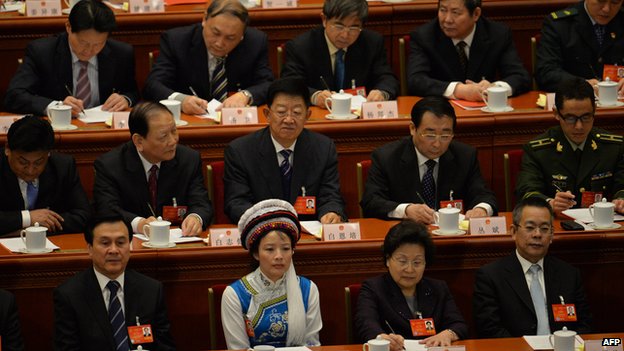
The Chinese Communist Party is said to be the largest political party in the world with millions of members
We've heard a lot about China's far-reaching anti-corruption campaign at the 
behest of President Xi Jinping. 

Less, however, has been made about the ruling Communist Party's latest 
crackdown on "moral corruption". 

While adultery may be frowned upon in China it is not illegal for ordinary 
citizens.

But according to
a report in the English-language newspaper China
Daily
, "adultery" is now  banned for party members.

The newspaper says that members were warned in June by the Communist Party watchdog that they must adhere to "higher moral standards" than the public.

It reported that six officials have already been found guilty of committing 
"adultery" - but did not say what punishments had been meted out. 

But just when you thought the party was taking a puritanical stand, the 
newspaper said that when authorities had previously accused officials of "moral 
corruption" they defined this as having more than "three mistresses".

In the public's eyes, mistresses have become the ultimate symbol of 
corruption. The common assumption is no official would able to buy his mistress 
a car or a home without pilfering from public funds.

According to a government report in 2007, an astonishing 90% of top officials 
brought down by corruption scandals had kept a mistress - and in many cases
they  had more than one.

But many see the Communist party preaching about morality as perverse and 
little more than a propaganda stunt.

When the former top leader, Bo Xilai, was first charged with corruption, 
prosecutors added rather gratuitously that he had "maintained improper sexual 
relations" with several women. 

The accusation may well have been true. But by putting sex on the charge 
sheet the authorities were seeking to blacken the politician's name before a 
trial even took place. 

The party must have hoped the public would focus on the moral failings of one 
man - rather than its own misdeeds.
0 Comments

China media: South Korea ties

7/4/2014

0 Comments

 
BBC News China - 4 July 2014 Last updated at 06:34

Chinese papers praise Seoul for "maintaining peace on the Korean Peninsula" and not "playing into the hands" of the US.
Picture
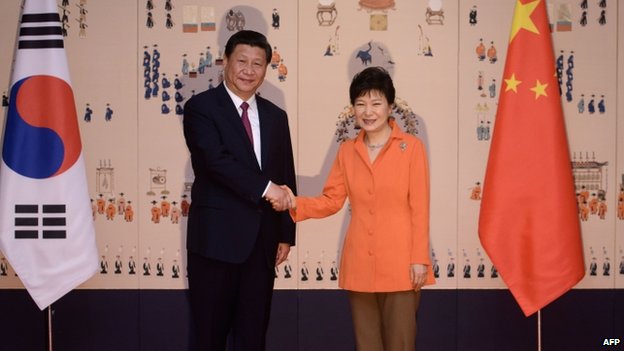
Xi Jinping and Park Geun-hye have pledged to further boost Seoul-Beijing ties
Beijing and Seoul reaffirmed their opposition to North Korea's nuclear tests during a meeting between visiting Chinese President Xi Jinping and his South Korean counterpart Park Geun-hye.

It is the first time a Chinese leader has visited Seoul before Pyongyang. At a joint press conference with Ms Park, the Chinese president said denuclearisation of the peninsula was a common goal and must be achieved through dialogue and negotiation.

Media and experts are mostly analysing Seoul and Beijing's role in "maintaining regional peace", but without being too critical of Pyongyang.

Wang Yiwei, an international affairs expert with Renmin University, says South Korea is a key player in maintaining a peaceful and nuclear-free Korean Peninsula.

"The world has over-emphasised the influence of US-North Korea or China-US ties without paying enough attention to South Korea's role in the issue," he is quoted as saying in a Xinhua report.

He adds that Beijing and Seoul have become "regional stabilisers" in the face of deepening territorial tensions, the rise of right-wing views in Japan and Pyongyang's nuclear problems.

The Global Times' Chinese edition notes that both China and South Korea have "all along remained rational".

It praises South Korea's "power balance", adding that Seoul has been "acting as a buffer between Beijing and Washington and it has gained more strategic interest than Tokyo".

It also describes Asian countries which "completely lean on the US for security" as "foolish" and warns that these countries "have a childish fantasy thinking that the US will support them when they confront China".

War history Elsewhere, the State Archives Administration has started publishing confessions made by 45 Japanese war criminals tried and convicted by military tribunals in China after the second World War.

The handwritten confessions, along with translations in Chinese and abstracts in both English and Chinese, will be published online every day over a 45-day period starting from Thursday, according to the Beijing News.

"We are releasing these archived documents as hard evidence of the crimes that Japan committed on the Chinese people," Li Minghua, deputy director of Central Archives of China, said on Thursday.

He added that the release of the documents can be seen as "a strike-back action on right-wing forces in Japan" because Tokyo was trying to "beautify its invasion history".

The China Daily welcomes the publication of the documents.

"The decision by China's State Archives Administration to publish the handwritten confessions of convicted Japanese war criminals deserves applause because it provides solid counter-evidence to what the brazen Abe and his like-minded compatriots are peddling about their country's war of aggression," it says.

Echoing similar sentiments, Zhu Chengshan, director of Nanjing Massacre Memorial, suggests that China should "lodge an international case against Japan for infringement of human rights".

BBC Monitoring reports and analyses news from TV, radio, web and print media around the world. For more reports from BBC Monitoring, click here. You can follow BBC Monitoring on Twitter and Facebook.

0 Comments

China to build new East Africa railway line

5/12/2014

0 Comments

 
BBC News Africa
12 May 2014 Last updated at 00:26

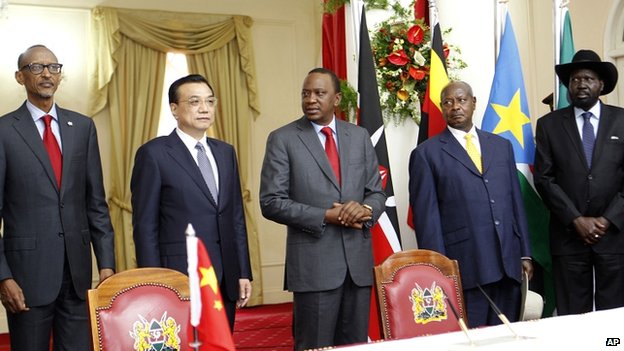
Formal agreements for plans to build a new railway line in East Africa with Chinese help have been signed in the Kenyan capital Nairobi.
Picture
Regional leaders and visiting Chinese Prime Minister Li Keqiang attended the signing ceremony
It is to run from Mombasa to Nairobi and will extend eventually via Uganda to Rwanda and South Sudan.

In Kenya, the line is to replace a narrow-gauge track built more than 100 years ago during British colonial rule.

China is to finance 90% of the cost of the first stage, put at $3.8bn, with work carried out by a Chinese firm.

Construction work on the standard gauge line is expected to start in October this year, and the 610 km (380-mile) stretch from the coast to Nairobi is due to be finished in early 2018.

"The costs of moving our people and our goods... across our borders will fall sharply," Kenyan President Uhuru Kenyatta told a news conference after the signing.

Mr Kenyatta has previously said the new link should cut the cost of sending a tonne of freight one kilometre from 20 US cents to eight, Reuters news agency reported.

The costs of moving our people and our goods across our borders will fall sharply”

End Quote Uhuru Kenyatta Kenyan President
"This project demonstrates that there is equal co-operation and mutual benefit between China and the East African countries, and the railway is a very important part of transport infrastructure development," said Chinese Prime Minister Li Keqiang.

A subsidiary of China Communications Construction Co has been named as the main contractor.

According to the terms of the agreement, China's Eximbank is to provide 90% of the cost of the first phase of the line, with Kenya putting up the remaining 10%.

After that stage is complete, it is planned that work on the links to other countries in the region will start.

Construction of the original line began in Mombasa 1895 and the railway reached Nairobi in 1899.

It reached the shore of Lake Victoria in December 1901.

During the difficult and often dangerous work, at least 2,000 workers lost their lives - many of them Indian labourers imported to East Africa to build the railway.

Malaria, dysentery and other diseases took their toll as well as accidents and wild animals. 
0 Comments

Chinese internet giant Alibaba eyes US share sale

5/7/2014

0 Comments

 
BBC News China
7 May 2014 Last updated at 16:43 BST 

Chinese internet giant Alibaba has filed documents for a public share sale in the US, which is widely expected to be one of the biggest in history.

In its filing, the company said it was seeking to raise $1bn (£589m). But that figure is seen just as an estimate to calculate various fees.

Analysts expect it to raise more than $15bn and top Facebook's share sale.


John Sudworth reports from Shanghai.
Picture
0 Comments

China corruption campaign: On the trail of Zhou Yongkang

5/5/2014

0 Comments

 
Picture
By Carrie Gracie
BBC China editor


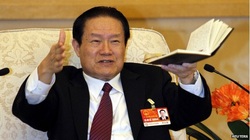
PictureZhou Yongkang
Where is Zhou Yongkang?

A question all of China is asking but I didn't expect an elderly man to stop by the pond in Zhou's home village and press me for answers.

Until recently one of China's most powerful politicians, Zhou Yongkang has simply disappeared, presumed victim of the Orwellian security apparatus he once controlled.

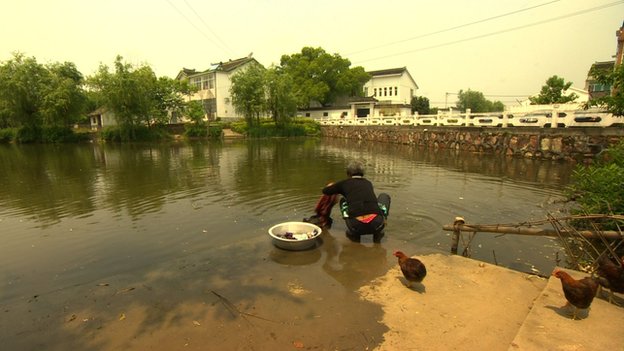
In this picture postcard scene complete with ducks on the pond and hens on the green, the whitewashed family compound was giving nothing away to the trickle of scandal hunters loitering at the gate.

And in faraway Beijing, Zhou's name has not been mentioned in the official media for seven months.


Picture
Zhou Yongkang's home village of Xiqiantou, in Jiangsu province, is giving nothing away
Why should we care? After all, this is a man who retired 18 months ago and who even most Chinese wouldn't recognise. If he's come unstuck in the kind of palace politics he once played so well, his prison cell will be no worse than those he forced so many others into during his years running a brutal security system.

But stand back from the hens and the ducks and listen to the deafening silence from Party high command. Zhou Yongkang's story goes to the heart of China's stability and reform momentum. The fight to bring him down is the politics to watch.

Most feared


Zhou Yongkang's career is a Chinese style rags to riches fairytale.

His family were hard pressed farmers who fished for eels to supplement their income. The parents encouraged their three sons to study and the eldest repaid them by going to university and becoming an oil engineer. He accelerated through Party ranks to run China's biggest oil company and then a province of 80 million, crowning his career with a seat at the Party's top table and control of the vast internal security apparatus.

Beyond his home village, he could never have claimed to be the most loved man in China but until 18 months ago he could claim to be the most feared.

Picture
At that point Zhou's luck changed. Xi Jinping took up the leadership of the Communist Party and announced a campaign against corruption. A war on 'tigers as well as flies' he warned.

Zhou Yongkang is his chosen tiger. But why go looking for a fight with a dangerous predator?

Taking on the tiger


"Three reasons," says political analyst Deng Yuwen.

We were talking over a game of 'go', the board game of black and white stones that strategists have been playing for two thousand years because it sharpens their wits for the real game of politics.

"The first reason for taking on this tiger, is to consolidate power and gain respect.

"The second is to push forward reform. There are lots of powerful people in government whose wealth is not clean, and they all have a vested interest in the status quo.

"If you want to reform the economy now, you have to find a place to break through their lines. Zhou Yongkang is that place.

"The third reason is to improve the image of the Communist Party."

This all makes sense to me.

On consolidating power, China's one party political cycle offers no electoral mandate to an incoming president. Taking out a rival with a corruption trial clears space for one's own people and policies.

Reform also adds up. After a decade of delaying vital changes, China needs political direction.

The incoming leadership seems resolved to restructure an economic model which has seen stunning growth for 30 years but which most agree is unsustainable. One of the most unsustainable things about it is the stranglehold of state behemoths in key sectors, many of them controlled by the Party elite. Remove them and Xi has room to reform. Witness the purge of Zhou Yongkang's placemen from the oil and gas industry over recent months.

As for improving the image of the Communist Party, this too is urgent.

It's hard to exaggerate the depth of public cynicism about the political class. We're not talking about a Westminster expenses scandal over the odd duck house or extra apartment. As the Chinese economy has surged, senior Party officials have used their monopoly on power to plunder billions from the public purse, many hiding their fortunes in offshore accounts and foreign assets.

If he [President Xi] tries to fight Zhou to the death, Zhou will take him and the Party to the bottom”

End Quote Deng Yuwen Political analyst
'Plucking fur' In Zhou Yongkang's case, the respected financial journal Caixin has traced a web of business interests which it says made the Zhous spectacularly rich.

Now assets have been seized and family members, drivers, bodyguards, secretaries and proteges have all been detained.

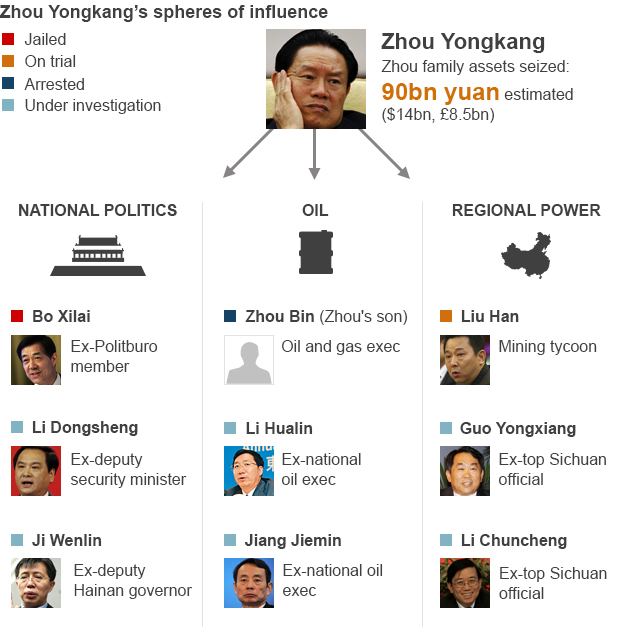
While Zhou Yongkang's name is unspoken in the media, there is an almost daily scandal feed about allies from his networks of influence, whether in the energy sector, in Sichuan province or in the security system.

"Xi is plucking the fur from the tiger," says Deng Yuwen, sweeping one of my poorly-defended troop formations from the go board as if to demonstrate how it's done.

But it's hard to judge whether the public will draw the conclusion Xi Jinping wants from all of this.

How much Party scandal can they bear?

Last year saw the trial of former Chongqing Party Secretary Bo Xilai, a spectacle which lifted the lid on the crime, corruption and downright depravity that passed for politics in one of China's largest cities.

But Bo Xilai was only on the Politburo, i.e. in the squad but not the first team.

If Zhou faces trial on corruption charges, he will be the most senior leader to do so since the Communists took power in 1949. Serious brand damage for the Party.

Xi Jinping has two other vital calculations.

Cornered 

Since the beginning of the reform era, members of the Standing Committee have left each other's families and business interests alone.

They all remember the purges and show trials of their parents' generation and know from experience that doing their dirty washing in public leads to bloodletting and chaos.

Now Xi Jinping has broken that pact and the other top families will ask each other who is safe and who is next.

Also, a cornered tiger is still a dangerous tiger. The former security chief knows all the innermost secrets of the elite, including plenty about Xi Jinping's family which might be damaging if made public.

Zhou may be cornered but he still has claws that could do Xi Jinping a mortal injury.


As Deng Yuwen puts it: "If he tries to fight Zhou to the death, Zhou will take him and the Party to the bottom. They will die together.

"Xi has to leave Zhou a stake in keeping the Party afloat. That's what they're fighting over now."

On the go board, I conceded defeat to Deng Yuwen and we poured the black and white stones back into their woven baskets.

As the weeks and months go by without a clear outcome, the battle on the big board remains the one to watch. Everyone is waiting uneasily to see whether this president can tame his tiger.


0 Comments

China sacks former security chief Zhou Yongkang's associate

4/9/2014

0 Comments

 
BBC News China - Chinese authorities have sacked another associate of Zhou Yongkang, in the latest apparent move targeting the powerful former security chief.
Picture
China's anti-graft body said Guo Yongxiang had taken bribes
The Communist Party's anti-corruption watchdog said that Guo Yongxiang, a former vice-governor of Sichuan province, had been expelled from the party and removed from office.

A statement said Mr Guo had taken bribes and was "morally corrupt".

The move comes amid speculation that Mr Zhou is being investigated.

Mr Zhou was the party secretary in Sichuan province before becoming head of China's Public Security Ministry in 2003.

A highly influential figure, he was a member of China's top-most decision-making body, the politburo Standing Committee, and was seen as a mentor to now disgraced former high-flier Bo Xilai.

In recent months, several top officials from Sichuan province linked to Mr Zhou have come under scrutiny.
  • Ji Wenlin
    Vice governor of Hainan; Zhou's secretary when he was Minister of Land and Resources and of Public Security.

  • Guo Yongxiang
    Chairman of the Sichuan Cultural Association; Zhou’s secretary when he was Sichuan party boss; expelled from the party.

  • Li Hualin
    Deputy General Manager of CNPC; was Zhou’s secretary when he was the deputy general manager of CNPC 1988-92.
  • Source: Xinhua News Agency
There has been no official confirmation that any investigation into him is under way, however, despite persistent rumours.

The investigation into Mr Guo, who worked under Mr Zhou in Sichuan province, was announced in June last year.

According to a Xinhua news agency report citing the anti-graft watchdog, Mr Guo had "seriously violated laws and party disciplines, and he is also suspected of the crime of bribe taking".
0 Comments

The real costs of China's anti-corruption crackdown

4/3/2014

0 Comments

 
By John Sudworth
BBC News, Shanghai

Much has been written about China's ongoing crackdown on corruption, but now one of the world's biggest banks has put a price on it.
Picture
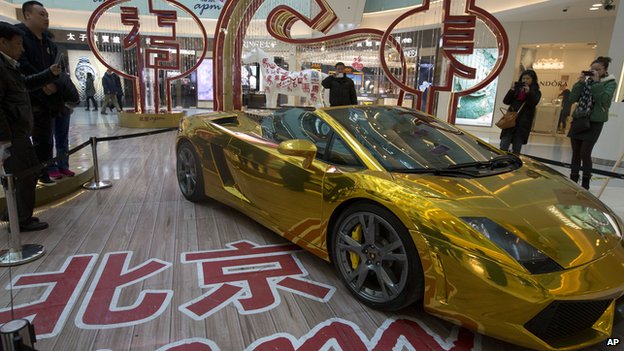
China has seen a decline in the sales of luxury goods since the drive to root out corruption began
According to a report published by Bank of America Merrill Lynch this week, the Chinese government's anti-graft campaign could cost the economy more than $100bn this year alone.

That's a lot of economic activity, something not far off the total size of the economy of Bangladesh, which supports some 150 million people (although admittedly not very well).

Macro effectsMany of the micro effects of Xi Jingping's anti-corruption drive have already been well documented of course; a slowdown in the restaurant trade for example, and a big dip in sales of luxury goods.

Over the past year or so, in Shanghai's posh malls and boutique designer shops - once at the centre of the happy merry-go-round of official largesse and gift giving - you've almost been able to hear the sound of the weeping and gnashing of teeth.

But the BofAML report suggests that the campaign is also having a significant and troubling macroeconomic effect.

Picture
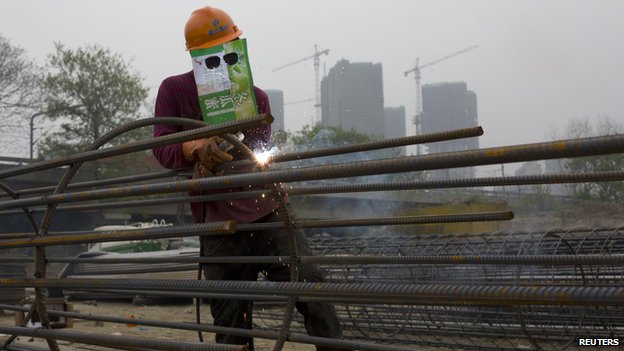
Officials are reluctant to spend public money on projects fearing corruption allegations against them
Since early last year, it says, government bank deposits have been soaring, up almost 30% year on year.

Even honest officials, the report suggests, are now so terrified of starting new projects, for fear of being seen as corrupt, that they're simply keeping public funds in the bank.


he total cost to the economy of the prohibition on government consumption and the chill on administrative spending is an estimated reduction in growth of at least 0.6% this year.

But it could, the report argues, be as high as 1.5% which, by my rough calculation, gives us the figure of about $135bn of lost economic activity.

The report's authors admit their calculations are a "back-of-the-envelope estimate of fiscal contraction", but even if they are only half right it is an extraordinary amount of money and it highlights some of the challenges facing China's anti-corruption crusader-in-chief, President Xi Jinping.

Since taking office more than a year ago he has made the cause his defining goal, warning that official graft and extravagance threaten the very survival of the ruling Communist Party.

Sex tradeEarlier this week, an unconfirmed news report gave a tantalising glimpse of the seriousness of the project, claiming that the Chinese authorities had seized from the family and cronies of just one individual (Zhou Yongkang, the former powerful politburo member) assets worth more than $14bn.

Picture
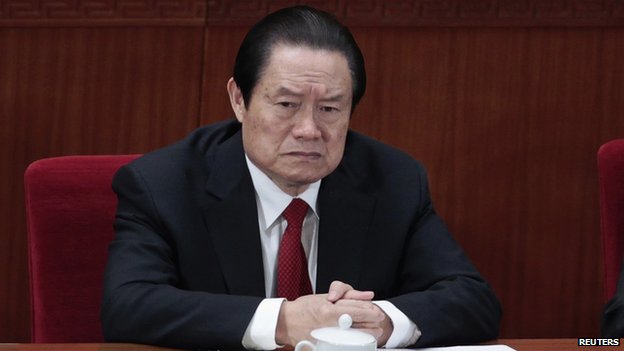
Zhou Yongkang was a powerful politburo member and head of China's Public Security Ministry in 2003
Picture
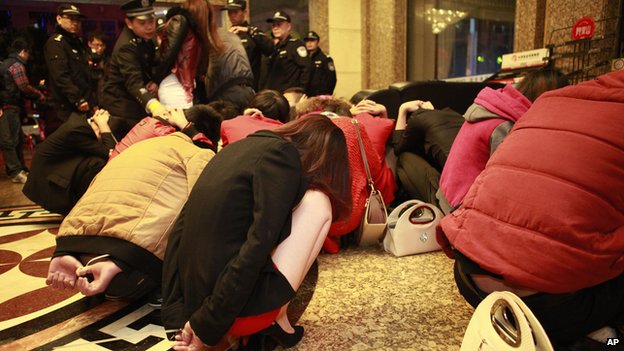
China's sex trade has become a target of the anti-corruption clampdown
The BofAML report gives a clear sense of just how entwined corruption has become with Chinese economic growth.

It is not often that you find corporate bankers discussing the macroeconomic importance of prostitution, but they do so to make a point.

This year, the report points out, the anti-corruption campaign has been stepped up a gear and has targeted the sex trade in dozens of cities.

This has had an adverse impact on some businesses in the service industries, it says.

So perhaps today, Chen Yun would add a third observation to his musings about the difficult balance to be struck when tackling corruption - never mind the Party, fighting graft too hard just might destroy China's economy too.

0 Comments

Chinese 'mafia-style' gang goes on trial

3/31/2014

0 Comments

 
BBC News China - The trial of a "mafia-style gang" in China accused of gunning down rivals, bribery and corruption has begun, state media say.
Picture
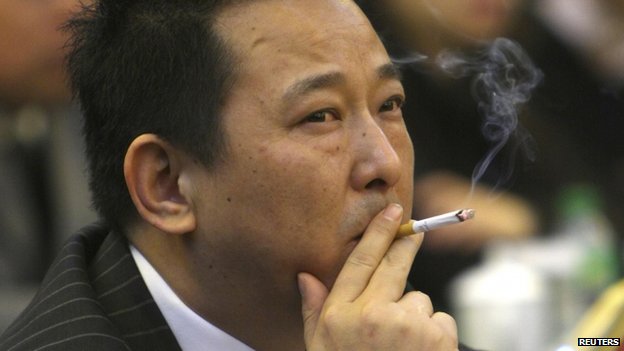
Liu Han has previously been ranked amongst China's 500 wealthiest people
Liu Han, ex-head of mining conglomerate Sichuan Hanlong Group, stood trial on Monday at a court in Xianning with his brother Liu Wei and 34 others.

The trial comes amid a crackdown on corruption by President Xi Jinping.

The Liu brothers are charged with 15 crimes including murder, assault and illegal detention.

Their gang, active since 1993, are being charged in connection with nine murders.

Sichuan link


Liu Han has been detained since March last year.

He was ranked 148th on Forbes' list of the richest Chinese business people in 2012 and his former company, Sichuan Hanlong Group, once tried to take over Australian miner Sundance Resources Ltd.

Chinese state media said that the Sichuan-based gang had had strong political ties that played a role in Liu Han's appointment as a delegate in Sichuan's political advisory body.

In recent months, several top officials from Sichuan province have come under scrutiny.

These investigations have come amid rumours that ex-security chief Zhou Yongkang is being investigated for corruption.

Mr Zhou was the party secretary in Sichuan province before becoming head of China's Public Security Ministry in 2003.

There has been no official confirmation that any investigation is under way.

0 Comments

China and Japan: Seven decades of bitterness

2/13/2014

0 Comments

 
BBC News, 13 February 2014 Last updated at 21:17

A dispute over islands in the East China Sea has inflamed relations between Japan and China for the last two years - but they were tense even before. The BBC's Mariko Oi visited both countries with a Chinese journalist to find out why the wounds of World War Two refuse to heal.
Picture
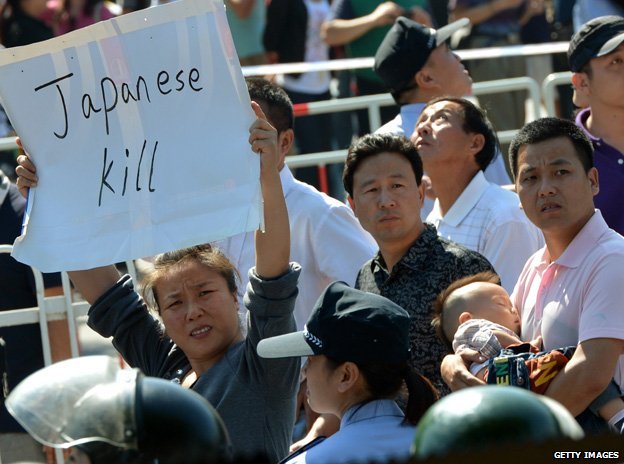
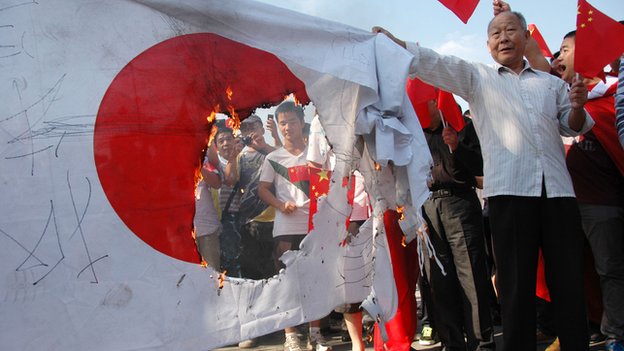
A woman holds up an anti-Japanese sign during a protest in September 2012
"Do you feel guilty about what Japan did to China during the war?" It was a question that I had to translate more than once during a trip to Japan with Haining Liu, a former reporter for China's state broadcaster, CCTV.

It was Haining who posed that question to some of our interviewees - the oldest of whom would have been a child in 1945.

"I feel sorry for what happened," said one man. "There were many regrettable incidents," said another.

"But maybe my regret isn't enough?" added one of them, a Japanese nationalist, who argues that most school textbooks exaggerate the abuses carried out by Japanese soldiers. "No," Haining responded. "It's not enough."

There are some undisputed facts. Japan was the aggressor, occupying Manchuria in northern China in 1931. A wider war began in 1937, and by the time Japan surrendered in 1945, millions of Chinese had died.

A notorious massacre occurred in the city of Nanjing, which was the capital under the Kuomintang government. Atrocities were also carried out in other Asian countries.

But it made me feel uncomfortable every time I had to translate the word "guilt" into Japanese. And none of our Japanese interviewees would use it.

Picture
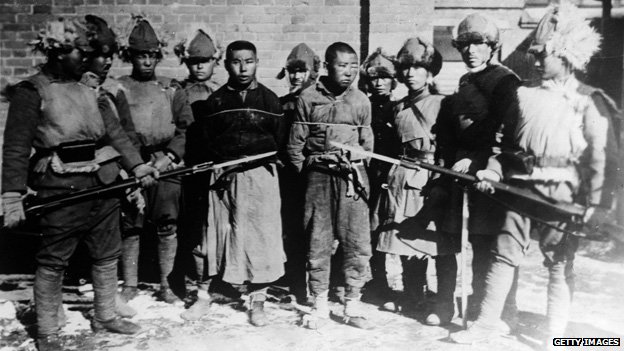
Prisoners of war in Manchuria, 1931
Should today's generation bear the responsibility for past mistakes?

I put that question to Haining on our second day together, asking if she thinks I should also feel guilty. She didn't say "Yes" or "No".


"I will keep asking the question while I'm here," she said. "Because that is how many Chinese people feel."

I personally became interested in the history of World War Two as a teenager. Over the years I have researched the topic quite thoroughly. Many of my holidays have included a trip to war museums across Asia, in an attempt to understand the damage and suffering Japan caused.

I have long felt that I was not taught enough at school, so last year I wrote an article about the shortcomings of Japan's history education. It pointed out that the syllabus skims through more than a million years of Japan's relations with the rest of the world in just one year of lessons. As a result, many Japanese people have a poor understanding of the geopolitical tensions with our neighbours.

My article made many people in my home country, including some of my own family, uncomfortable.

It was not a foreigner criticising Japan, it was a Japanese reporter openly criticising Japan in front of global audience.

"Traitor" and "foreign spy" are just two of the many names I was called. "Don't you love your own country?" one person asked on Twitter. Of course I do.

When I confronted Japan's past, it was like experiencing a bad breakup. I went through similar stages - shock, denial, anger and sorrow. I eventually came to accept that I could not change what had happened.

Picture
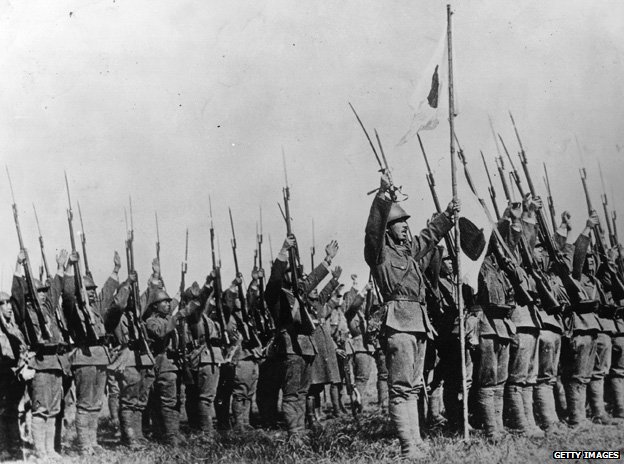
Japanese soldiers celebrating, 1941
But especially after watching violent anti-Japanese protests in China in 2012, I wanted to ask two questions.

Is there anything we can do to improve our relationship? And why don't other Asian countries, where the occupying Japanese army also killed many civilians, hate the Japanese as much as China and South Korea do?

"Hate" may be a too strong word - but it seemed to me to describe the feelings of Chinese protesters who were burning Japanese cars.

Picture
This isn't how Haining sees it. When she grew up in the 1980s and 90s, Japanese pop culture - music, drama, and manga - was popular with young Chinese people. She and her friends, she says, had a positive attitude towards Japan.

"But I cannot speak for every Chinese person, 1.3 billion of us, for China is a vast country, and people are entitled to have their personal feelings," she says.

"For example, among those who lost close family members because of Japan's invasion, or among those who actually suffered a great deal during the war, hostility or even hatred might still remain. They shouldn't be judged because of that."

Singapore, where I've lived since 2006, also suffered at the hands of Japanese soldiers, but there have not been anti-Japanese protests there for decades.

Different sources cite different numbers of casualties, but 50,000 to 100,000 ethnically Chinese Singaporeans are believed to have been killed in what is known as the Sook Ching massacre. In a small city state of some 800,000 in 1942, that is a huge number.

I met a relative of one victim at the Civilian War Memorial on Beach Road.

"I don't blame today's generation," said Lau Kee Siong, to my surprise. I asked him why he was so much less angry than those Chinese protesters.

"We are a country of immigrants so our basic philosophy is that we must survive," he said.

"When we became independent from Malaysia in 1965, the general assumption was that we had about three years before we would have to crawl back into Malaysia. So when Japan came along and offered financial support and investments, the most logical thing was to accept them instead of criticising what they had done to us in the past."

Picture
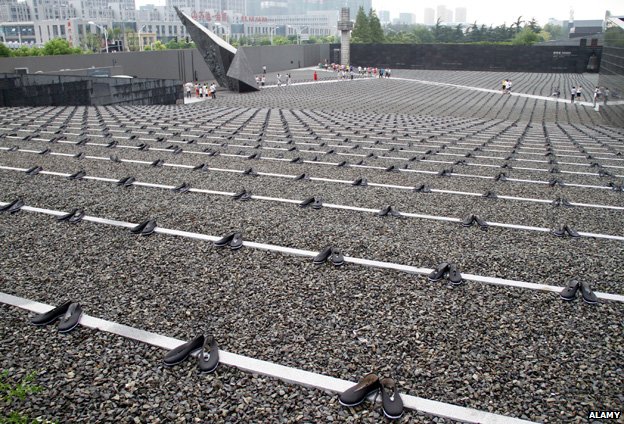
Thousands of pairs of shoes are laid out at the memorial to the Nanjing Massacre
At about the same time, I also found out that some relatives of one of my closest friends, Jade Maravillas, had been killed under the Japanese occupation in the Philippines. Even though we had been friends for years, she had said nothing about it until she read my article because she thought "it may make our friendship awkward".

"Many people including my great uncles and aunts were staying at De La Salle University during the war," she said.

"The Japanese soldiers raided the school and my great uncles were killed. One of the aunts was stabbed but survived and showed me her scar when I was a teenager."

I wondered if she held any grudges against the Japanese. "Didn't you think about your relatives when you first met me?" I asked.

"Are you kidding me? My partner is half-Japanese," she laughed. "And it's not your fault."

I asked Jade too if she could explain why her views about Japan were so different from those held by many Chinese.

"I'm not sure," she said. "But to us, Japan was just another colonial power after the Spanish."

In fact, China also seemed to be heading towards a pragmatic relationship with Japan in the 1970s, under Chairman Mao Zedong, when the two countries restored diplomatic relations.

"Chinese Communist propaganda at the time emphasised the victory of the communist side during the Chinese civil war," says Robert Dujarric, director of Temple University's Institute of Contemporary Asian Studies - referring to the war between Mao's Communists and nationalists under Chang Kai-shek, which lasted until 1949.

Picture
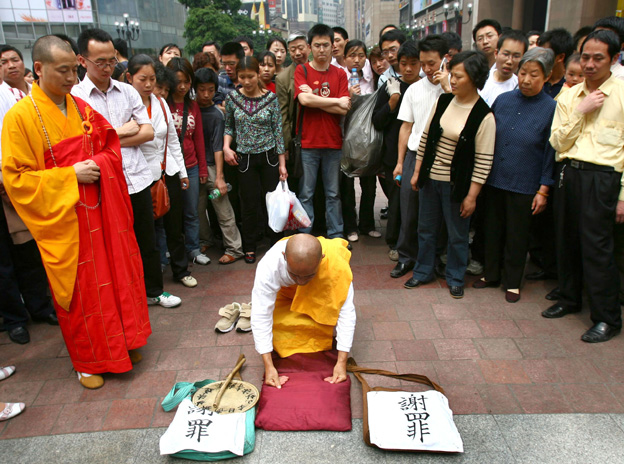
A Japanese monk visits Chongqing in 2006, to apologise for war crimes
In 1972, when the then Japanese Prime Minister, Kakuei Tanaka, apologised for what Japan did during the war, "Chairman Mao told him not to apologise because 'you destroyed the Kuomintang, you helped us come to power'," Prof Dujarric says.

But the Party's propaganda seems to have taken a turn towards nationalism after the Tiananmen Square massacre, in which the Chinese army crushed to death students who were demanding democratic rights, on 4 June 1989.

"Before the 4 June, it portrayed the Communist Party as victorious and glorious - it defeated the nationalist Kuomintang army in the civil war. But after 4 June, the government started emphasising China as a victim," says Prof Akio Takahara, who teaches contemporary Chinese politics at Tokyo University.

The Communist Party now casts itself as the party which ended a century of humiliation at the hands of outsiders, he says.

"And the way they do it is to breed hatred against the most recent invader and aggressor."

Switching on the television in my Chinese hotel room, it was easy to find television programmes dramatising China's resistance to the Japanese invasion. As part of the country's "patriotic education" policy, more than 200 were made last year.

We spoke to an actor who "died" eight times a day, playing the role of a Japanese soldier in countless anti-Japanese dramas.

Had I grown up watching them, I would probably conclude that Japan was a horrible nation.


A similar message seemed - at least to me - to be contained in an assembly we observed at a primary school in south-western Beijing. A succession of young children led the group in song, rhymes and martial arts. One of the poems was about an incident at the nearby Marco Polo Bridge in 1937 - an event seen by many as the start of the last war between China and Japan.

Is this message about Japan justified? I am honestly torn. As we visited different parts of China and spoke to survivors of Japan's atrocities, my heart ached.

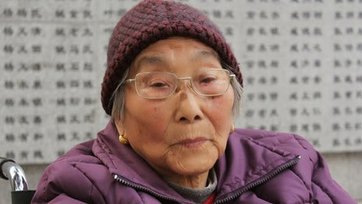
One survivor was Chen Guixiang, who had been a 14-year-old girl in Nanjing in December 1937, when the massacre took place.

Dead bodies were piled up outside a school, she said. She witnessed a girl of her own age being raped by seven Japanese soldiers, then killed with a knife.

Twice she was almost captured and raped herself - only escaping, on the second occasion, because the soldier carrying her slipped and loosened his grip. She ran until she collapsed with exhaustion and was hidden by a Chinese farmer under a pile of grass.

PictureChen Guixiang remembers bodies being piled up outside her school
It was a bitter experience to listen to such accounts of the actions of Japanese soldiers. The one small crumb of consolation in Chen Guixiang's story was a postscript. Years later, when she travelled to Japan to recount her experiences, people hugged her and apologised, saying they had no idea their ancestors had done such things.

Japan's leaders have also apologised to China many times.

Ma Licheng, who used to write for China's state-owned People's Daily newspaper, says he has counted 25 apologies from Japan to China overall. But none of these - nor Japan's financial aid to China, amounting to 3,650bn yen ($35.7bn; £21.8bn) over the years - have been covered in the Chinese media, he says, or taught to children at school.


"What Japan did in China during the war was horrible," Ma wrote in his book Beyond Apologies. "But demanding that they kneel on the ground is pointless. The wording of the Japanese apologies may not seem enough to us, but to them, they were a huge step so we have to accept them and move on."

When he published his book, he was called a traitor - a response he describes as "normal", given the emotions the subject stirs.

Haining confirms that she was not taught about these things at school. On the other hand, she doesn't think it would make a big change to Chinese attitudes towards Japan, even if children did learn about them.

"Changing public attitude takes time, several years or maybe a decade. Thus, it is also up to Japanese leaders to keep a consistency in their actions and words," she says.

"People might feel favourable towards Japan after knowing more about Japan's apologies in the past, and economic contributions.

"However, one statement denying the existence of the Nanjing Massacre, or similar intentions to glorify war crime, would destroy the trust immediately, and it would take much longer to rebuild that kind of trust again."

In 2012, the mayor of Nagoya, Takashi Kawamura, a prominent nationalist, denied there was a massacre at Nanjing, saying there were only "conventional acts of combat". Last year, he made clear his views had not changed.

It also infuriates China and South Korea when Japanese leaders visit the Yasukuni shrine, which honours the country's war dead - among them convicted war criminals.

It's hard to see this kind of thing coming to an abrupt halt.

At the end of our trip, I was pleased that Haining answered the question I posed on day two. She said she didn't think I should personally feel guilty.

But we both felt less optimistic about our nations' future relationship than we had when we set out.

It still troubles me that generations of Japanese children have learned little about the atrocities our forefathers committed in China. And that young Chinese people don't know that our nations had begun to put the war behind them in the 1970s and 80s - until Tiananmen Square.

Haining sees no chance of reconciliation "if leaders in both countries keep adopting the current policies against each other".

"We have a chance to improve relations, at least, on the public or grass-root level by increasing honest and open conversations," she says.

"War is not an option, despite how difficult it is… We must try everything possible."

Listen to the first part of Missing Histories - China and Japan on the BBC World Service, on Saturday 15 February

Follow @BBCNewsMagazine on Twitter and on Facebook


0 Comments

Japan sets out defence strategy amid China tensions

12/17/2013

0 Comments

 
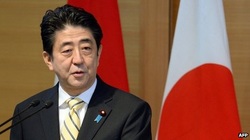
PictureJapan PM Shinzo Abe
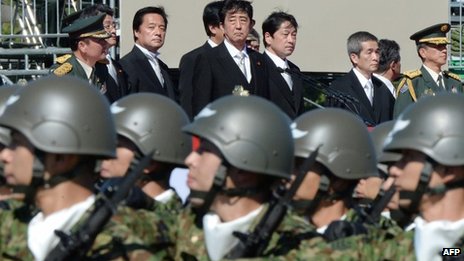
Japan's cabinet has approved a new national security strategy and increased defence spending in a move widely seen as aimed at China.

Over the next five years, Japan will buy hardware including drones, aircraft and amphibious vehicles.

The military will also build a new marine unit, an amphibious force capable of retaking islands.

The move comes with Tokyo embroiled in a bitter row with Beijing over East China Sea islands that both claim.

It reflects concern over China's growing assertiveness over its territorial claims and Beijing's mounting defence spending.

"China's stance toward other countries and military moves, coupled with a lack of transparency regarding its military and national security policies, represent a concern to Japan and the wider international community and require close watch," the national security draft said.

'Transparent'Japan first increased defence spending in January, after a decade of cuts.

Prime Minister Shinzo Abe, who was elected a year ago, has called for Japan to broaden the scope of activities performed by its military - something currently tightly controlled by the post-war constitution.


Picture
Mr Abe says the new policy will be clear and transparent
He has also established a National Security Council that can oversee key issues.

Approving the national security strategy made Japan's foreign and security policy "clear and transparent - for both the Japanese people and all the world to see", he said.

The announcement comes weeks after China established an air defence identification zone (ADIZ) over a swathe of the East China Sea, including islands controlled by Japan.

It says all aircraft transiting the zone must obey certain rules, such as filing flight plans, or face "measures".

Japan, US and South Korea - which claims a rock that lies within China's declared zone - have strongly criticised the move, with the US calling it a unilateral attempt to change the status quo in the region.

China, meanwhile, says it is "closely watching Japan's security strategy and policy direction".

Mr Abe's government says the strategy is a measured and logical response to a real and increasing threat, reports the BBC's Rupert Wingfield-Hayes in Tokyo.

But others point out that Japan's security is already guaranteed by the US, which has tens of thousands of troops in Japan.

Many on the left here think Mr Abe is using the threat from China to pursue his own nationalist dreams, our correspondent adds.

0 Comments
<<Previous

    Author

    Graham Chua Lim, the Presentor of this news from BBC Network

    Archives

    July 2014
    May 2014
    April 2014
    March 2014
    February 2014
    December 2013
    November 2013
    October 2013
    September 2013
    August 2013
    June 2013
    May 2013
    March 2013
    December 2012
    September 2012
    April 2012
    May 2010
    October 2009
    August 2009
    September 2006

    Categories

    All

    RSS Feed

Powered by Create your own unique website with customizable templates.